Since we’re now in the era of LLM-based code writing, I’ve been working on writing more code using Claude Code. Obviously, one can say “Hey Claude, I want to build a snake game. I think it would be funny if the snake ate hot dog emojis,” and it’ll probably write something half-decent, but when it comes to larger projects, that kind of one-shot prompt doesn’t work so well.
To be fair, LLMs have been relatively decent at doing these one-shot prompts for simple projects in their training data for quite some time.
Obviously, the next step would be to improve one’s prompting skills. Write a design document, and have the LLM implement it. Maybe even have another LLM review the code.
The interesting thing is that Anthropic added the ability for Claude to have skills, which are basically Markdown files that contain instructions and prompts so that one can leverage the prompting ability of other people to do certain tasks. They’ve also added the ability to add plugins to Claude Code, which can contain multiple skills.
Given those two features, some pretty cool people made the Superpowers Claude Code plugin which adds skills like brainstorming that are automatically invoked whenever one uses a prompt similar to the one in the introduction, at which point Claude will start asking questions to clarify what one wants to build.
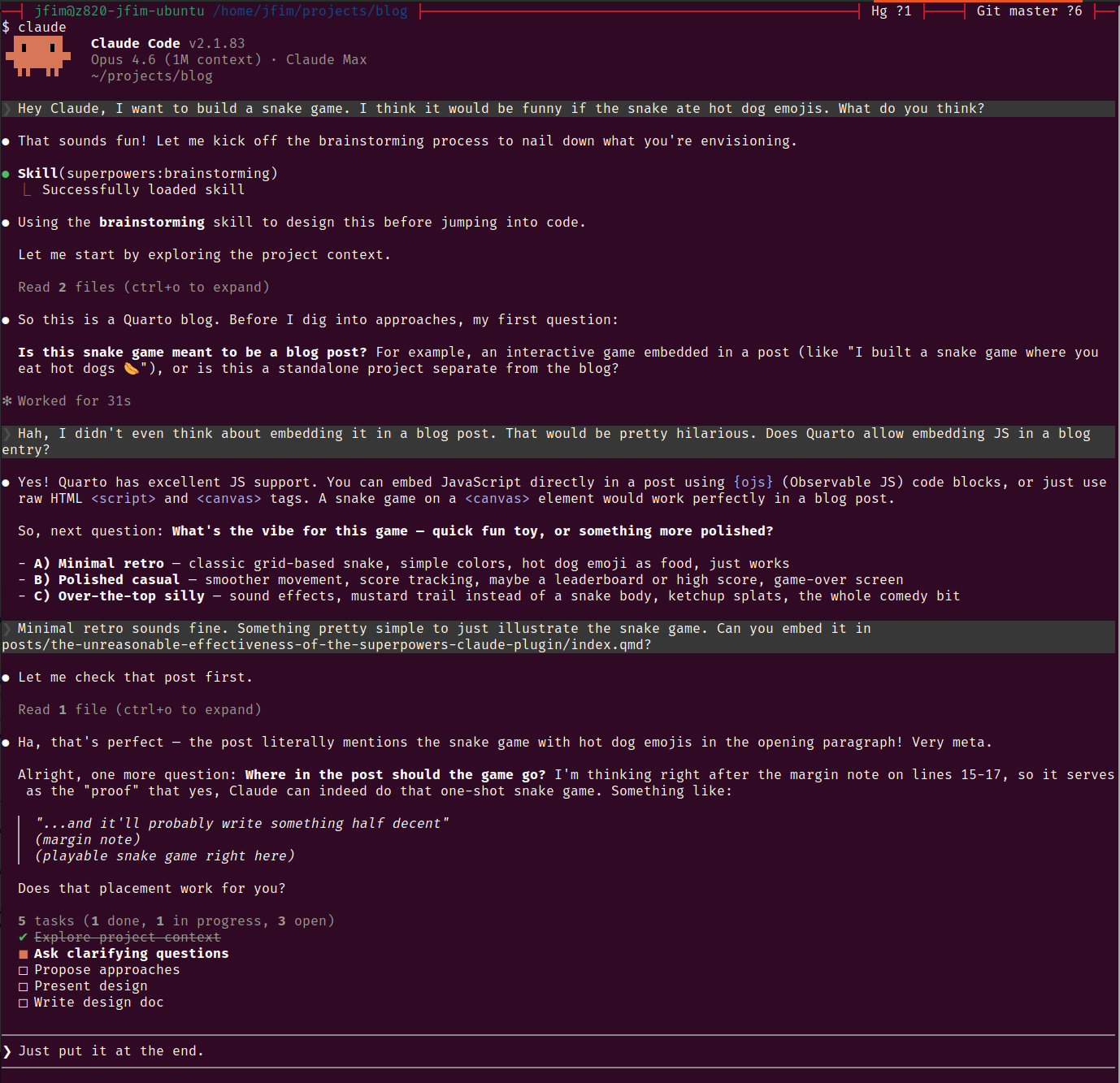
It’ll then proceed to draft a design which can then be iterated on through one or more review cycles, then draft an implementation plan, ask for a review, then code the whole thing automatically. Crazy, and after the implementation plan is approved, one can walk away from the computer and come back to something that works — at least if one has their permissions set correctly or runs with --dangerously-skip-permissions.
Obviously, the resulting code is only as good as the quality of the design, and you sometimes have to push back on design decisions that don’t work, but for turning random prompts into quick prototypes or funny snake games embedded in blog posts, it does work unreasonably well.